Q What is Yakisugi? How is it different from ordinary cedar boards?
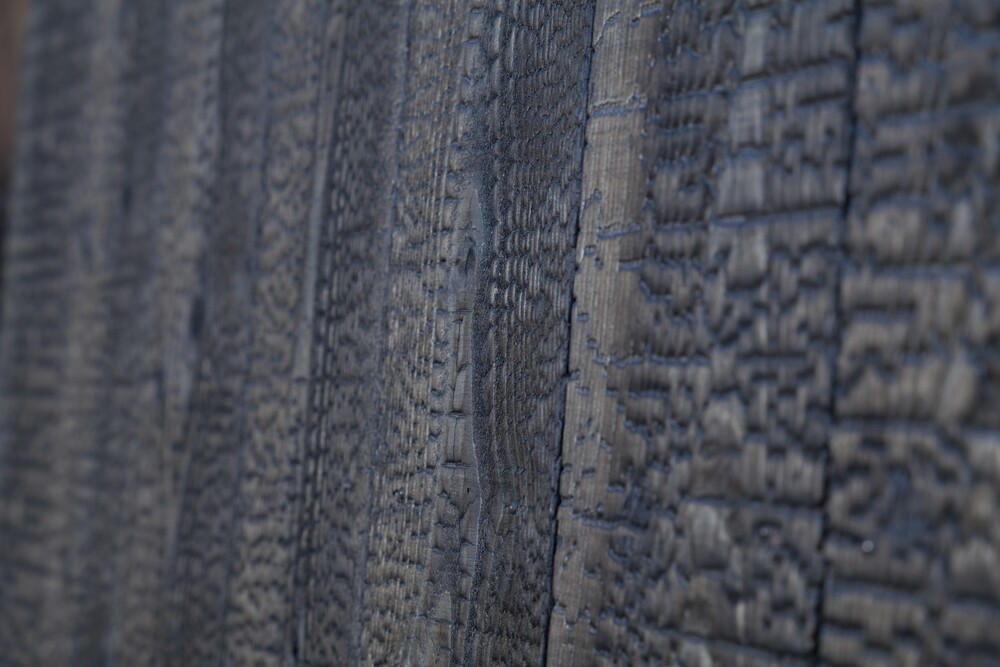
Yakisugi is a building material made by charring the surface of cedar boards. In Japan, it has traditionally been used as an exterior cladding material.
While the base material is the same as untreated cedar, the key difference lies in its durability against ultraviolet (UV) exposure. Compared with untreated cedar boards, Yakisugi has a carbonized surface layer that protects the wood from UV rays. This significantly slows down discoloration and deterioration caused by sunlight, allowing the deep black appearance to be maintained for a much longer period.
In addition, the carbonized layer helps prevent decay, and Yakisugi is more resistant to fire, as its ignition temperature is higher than that of dried, untreated wood.
We are sometimes asked, “Does Yakisugi have insect-repellent properties?” From the perspective of Kyoei Lumber, we believe there is no significant difference compared to untreated cedar in this respect.
At Kyoei Lumber, we not only produce traditional Yakisugi with a fully carbonized surface, but also develop a wide variety of finishes, including boards with the charcoal layer brushed off and boards with additional coatings or paint applied.
Related Questions
- Q What kind of cedar boards are used for Yakisugi?
- Q How was Yakisugi “Misugi” developed?
- Q How was Yakisugi “Gen” developed?
- Q What is the difference between black-painted cedar boards and Yakisugi “Gen”?
- Q What is the difference between the Triangle Charring Method and the Machine Charring Method used for Yakisugi?
- Q Are there any precautions when using Yakisugi in areas with heavy snowfall?
- Q What should be noted when installing Yakisugi?
- Q What led Kyoei Lumber to begin producing Yakisugi, and how has the business developed over time?